

Running in the footsteps of the Romans: 8 cities where the Roman Empire lives on
For nearly five centuries, the Roman Empire shaped much of Europe, leaving behind amphitheatres, temples, thermal baths and roads that still run through our cities today. From the ruins of the Roman Forum to the arenas of Nîmes, via the famous thermal baths of Bath, Rome’s legacy continues to fascinate travellers. But these destinations are far from the only ones… With JOOKS, set off on a real journey through time and discover eight European cities where traces of the Roman Empire are still clearly visible today, at your own pace, with anecdotes to accompany your walk and stories that have shaped these exceptional places.
Rome (Italy): Where it all begins

Our journey naturally begins in Rome. It was here that an empire was born which, over the centuries, would extend its influence from the Atlantic to the Middle East.
It is impossible to discuss the Roman heritage without starting with the Eternal City. As the capital of the Empire for centuries, Rome is home to some of the world’s most iconic ancient monuments: the Colosseum, the Roman Forum, the Pantheon and the Circus Maximus. But beyond these must-see sites, the whole city exudes a sense of antiquity. As you wander its streets with JOOKS, every turn reveals an ancient column, an old cobbled road or the remains of a forgotten temple. A unique immersion in the city that gave its name to one of the greatest empires in history.
Verona (Italy): The Empire conquers the Italian peninsula

Before crossing the Alps, Rome consolidated its hold over the entire Italian peninsula. Verona then became a prosperous city, whose impressive amphitheatre still bears witness to Roman power today.
Whilst Verona is world-famous for the legendary story of Romeo and Juliet, its Roman heritage is just as well worth a visit. Built in the 1st century, the arena is one of the best-preserved ancient amphitheatres in the world and still hosts operas and concerts today. As you continue your walk through the historic centre, you’ll also discover the remains of the ancient forum, the monumental gates and several sections of the Roman ramparts. It’s a chance to rediscover Verona from a perspective that’s often overlooked.
Lecce (Italy): The Mediterranean under Roman rule

As we continue our journey southwards, we discover how Rome is gradually transforming the major Mediterranean cities into genuine administrative and commercial centres.
Nicknamed the ‘Florence of the South’, Lecce captivates visitors above all with its Baroque architecture. Yet its Roman past is ever-present for anyone who takes the time to look closely. Its amphitheatre, partially uncovered in the heart of Piazza Sant’Oronzo, serves as a reminder of the importance of ancient Lupiae in the south of the Italian peninsula. Just a short walk away, the cobbled streets also tell the story of several centuries of history. Alternating between ancient monuments and Baroque palaces, our JOOKS routes allow you to discover a city where two great periods of history are in constant dialogue.
Nîmes (France): The arrival in Gaul
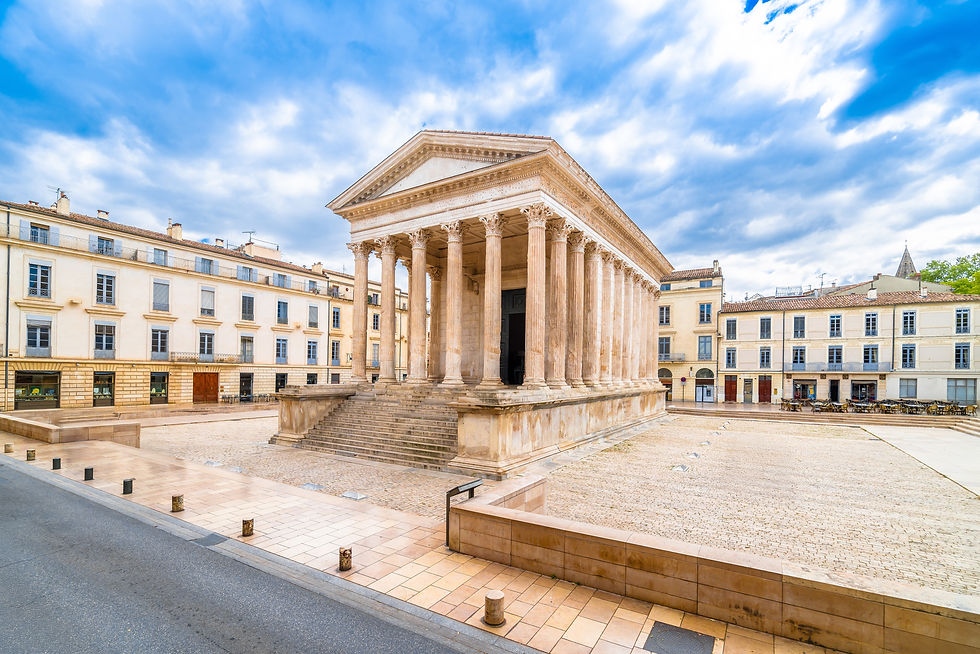
Our route now crosses the Alps. The Romans established a lasting presence in Gaul and founded cities that are now among the best-preserved in Europe.
Few French cities can rival Nîmes when it comes to Roman heritage. The remarkably well-preserved amphitheatre still dominates the cityscape, whilst the Maison Carrée is one of the best-preserved Roman temples in the world. The Tour Magne, a remnant of the ancient fortifications, offers a superb panoramic view of the city. Running or walking through Nîmes means following in the footsteps of the inhabitants of ancient Nemausus and understanding why the city is often nicknamed ‘the French Rome’.
Arles (France): A crossroads between Rome and Gaul

Thanks to the Rhône and its connection to the Mediterranean, Arles became one of the Empire’s major ports, where goods, soldiers and travellers crossed paths on a daily basis.
Listed as a UNESCO World Heritage Site, Arles was one of the most prosperous cities in Roman Gaul. Its amphitheatre, ancient theatre and mysterious cryptoporticoes still bear witness to this flourishing era. But Arles is more than just its ancient ruins: its bustling narrow streets, shaded squares and Provençal atmosphere offer a striking contrast to its rich ancient past. A walk with JOOKS allows you to explore these different facets whilst tracing nearly two thousand years of history.
Vaison-la-Romaine (France): Daily life in a Roman town

Not all Roman towns were major cities. Some, such as Vaison-la-Romaine, give us a better insight today into the daily lives of the Empire’s inhabitants, far from the capital.
Unlike other towns where only a few monuments have survived the centuries, Vaison-la-Romaine offers visitors the chance to explore a genuine ancient quarter. The remains of houses, streets, shops, thermal baths and the theatre offer a unique insight into daily life in a Gallo-Roman town. As you continue your walk to the medieval town, perched on its hilltop, you realise just how much the different eras have layered upon one another over the centuries. An ideal destination for understanding how the Romans lived far beyond the imperial capital.
Tarragona (Spain): The Conquest of Hispania

Our journey now continues beyond the Pyrenees. With Tarraco, Rome made the Iberian Peninsula one of the most prosperous provinces of its Empire.
The former capital of Hispania Citerior, Tarragona was one of the most important Roman cities on the Iberian Peninsula. Its impressive amphitheatre, overlooking the Mediterranean, is one of the finest ancient sites in Europe. But the city has much more to offer: the Roman circus, ramparts, forum and ruins scattered throughout the historic centre serve as a constant reminder of the importance of this ancient colony. Exploring Tarragona with JOOKS means wandering through a veritable open-air museum where Roman history blends harmoniously with the Mediterranean atmosphere.
Bath (United Kingdom): On the Edge of the Empire

Our journey ends in a place where few would expect to find traces of Rome. On the fringes of Roman Britain, the hot springs at Bath attracted the Empire’s builders, who founded Aquae Sulis there.
At first glance, Bath is best known for its elegant Georgian façades. Yet it is its Roman past that has made it famous. The famous thermal baths, fed by natural hot springs, are among the best-preserved Roman ruins in Northern Europe. As you explore the city with JOOKS, you’ll discover how the Romans transformed this place of worship into a thriving spa town, whilst enjoying the unique charm of a city listed as a UNESCO World Heritage Site.
Find all these cities and over 500 more on the JOOKS app!


Thanks for sharing this informative content. I like how the information is easy to follow and useful for people checking recent draws. Searching for resultado loteria can help readers find the latest available results more quickly and avoid confusion when checking their numbers.
I must express my gratitude for the exceptional reading experience you provided. It was without a doubt that I cherished every aspect of it. To review your most recent content, I have saved your website Wacky Flip.
I enjoyed reading every part of this post. It's refreshing to find content that's clear and easy to follow. I also recommend this online reflex test because it's a fun way to practice concentration, improve quick decision-making, and challenge yourself with every new attempt. 🚀
space waves doesn't choose to impress with spectacular cutscenes or a lengthy storyline; instead, it captivates players with the quality of its gameplay.