

Running in Limoges: the capital of the Limousin region
Nestled in the foothills of the Massif Central, Limoges is a vibrant city where life is good. Whilst it is best known for its porcelain, Limoges also boasts a diverse heritage full of surprises, shaped by over 2,000 years of history. A city of art and history, the capital of the arts of fire, and a UNESCO Creative City, Limoges is brimming with treasures and is sure to leave a lasting impression on everyone. Let yourself be guided through the streets of Limoges with the fitness and sightseeing trails offered by the city!

Although Limoges is the second most populous city in Nouvelle-Aquitaine after Bordeaux, it is nonetheless a city surrounded by nature. Situated on the banks of the Vienne, the city boasts numerous green spaces and gardens and is surrounded by a rural area free from intensive farming and livestock rearing.
But Limoges is also a city of fine dining, boasting a rich and varied regional cuisine, starting with the famous Limousin beef. Limoges’ specialities take centre stage every year at a major food festival: the Frairie des Petits Ventres. A culinary event that reflects the character of the inhabitants of the Limousin capital: a true feast for the senses and a warm, welcoming occasion.
The historic centres
Founded by the Romans around 10 BC under the name Augustoritum, Limoges is built around two historic centres: the Upper Town, the former district of the viscounts and Saint-Martial Castle, and the Lower Town, which was under the bishop’s authority and built around Saint-Étienne Cathedral. The castle and the Cité were united following the French Revolution, in 1792, to officially form a single municipality.
Your stroll through the city centre will take you on a journey of discovery through these two historic districts and the remarkable monuments and sites that line their streets. In the Upper Town, you’ll be captivated by the Cour du Temple and its magnificent half-timbered mansions, as well as its splendid granite arcades. You’ll also walk on cobblestones made from shards of ‘gazettes’—the clay ‘boxes’ used to protect porcelain pieces during firing—which form the paving of the Cour du Temple and other streets in the centre of Limoges. Medieval ruins stand alongside classical and modern buildings, such as the Central Market, which you’ll spot during your stroll. Built on the site of the former castle of the Viscount of Limoges in the late 19th century, the Market houses a large market and several restaurants. This majestic building has been listed as a historic monument since 1976.

The Cité district is no exception, as it is home, amongst other things, to the imposing Saint-Étienne Cathedral and the splendid Bishop's Gardens. The cathedral, whose construction spanned nearly six centuries, is one of the city of Limoges’ most iconic landmarks. During your stroll, take a moment to admire the delicate detail of the Saint-Jean portal or the splendid sculptures adorning the rood screen. Adjacent to the cathedral, the Bishop's Gardens offer a moment of tranquillity and a superb view of the Vienne River and the Saint-Etienne Bridge. Your exploration of Limoges would not be complete without a visit to the famous Limoges-Bénédictins station, one of the most beautiful in France. Its blend of Art Nouveau and Art Deco styles, its bell tower, its hall and its dome make it a must-see in the city.
Capital of the fire arts
It is impossible to talk about Limoges without mentioning its famous porcelain. First produced in the 18th century following the discovery of kaolin in the region (a white clay essential for making this hard, translucent ceramic), Limoges porcelain enjoyed its golden age in the 19th century and is now internationally renowned. Many prestigious manufacturers set up in Limoges during this period: Haviland, Bernardaud, Alluaud, Royal Limoges… Some are still in operation today. As you stroll through the town, you can marvel at the porcelain masterpieces adorning the façades of the bourgeois houses, the fountains and the Central Market. If you’re interested in the subject, do pop into the Adrien Dubouché Museum, which houses the world’s finest collection of Limoges porcelain.

As well as porcelain, Limoges is also renowned for its enamelwork and stained-glass windows. In the Middle Ages, pilgrims on the Way of St James flocked to admire the Abbey of Saint-Martial and its enamelwork. Although enthusiasm for enamel waned during the Renaissance, it enjoyed a revival in the 19th century, thanks to the Art Deco movement. An essential stop on your tour of the city, the Museum of Fine Arts boasts an exceptional collection of enamels dating from the Middle Ages to the present day. The art of stained glass also developed during the medieval period, particularly in religious buildings and with the emergence of Gothic art, and found new life with Art Nouveau and Art Deco in the early 20th century. You can admire the work of master glassmakers in the city’s many churches, as well as at the Pavillon du Verdurier and the railway station.
Along the River Vienne
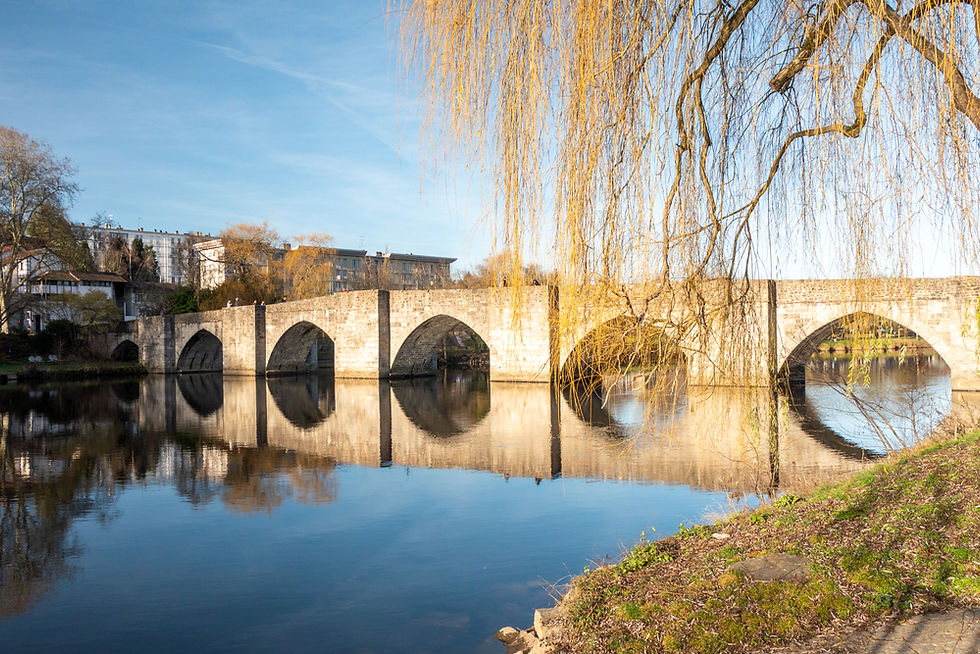
With its rich historical and cultural heritage, Limoges is also the perfect destination for nature lovers. The city has been awarded four flowers in the ‘Villes et villages fleuris de France’ competition for its significant natural heritage. For a real breath of fresh air, take the ‘The Banks of the River Vienne’ trail, which will lead you through the many parks and gardens that line the river. Don’t miss the lovely Jardin Nadalon, part of which is situated on the Île aux Oiseaux, a remnant of the Nadalon and Pénicaut factory, a former manufacturer of shoe heels.
As the River Vienne flows through the city of Limoges, its inhabitants have had to cross the river for several centuries. Over the years, a number of bridges have been built to link the historic city centre with the neighbourhoods on the left bank. Among them are the Saint-Etienne Bridge and the Saint-Martial Bridge, the city’s only two medieval bridges, which are entirely paved and exclusively for pedestrians. The residents of the ‘Quartier des Ponts’ (Bridge District), known as the Ponticauds, have been organising the ‘Fête des Ponts’ (Bridge Festival) for decades to mark the feast of Saint John.
Run, walk or cycle with JOOKS, from the Boucherie district to Saint-Etienne Cathedral!
Find all the routes in Limoges and over 1,700 more on the JOOKS app.


Enjoyed reading about Limoges! It sounds like a fantastic place to explore. Reminds me of how Chainsmoker Cat Manga brings a lot of joy and laughter to my day.
Limoges sounds like a wonderful city to explore, especially for people who enjoy combining culture, history, and outdoor activities. I love how the city offers scenic routes that allow visitors to discover landmarks while staying active. The mix of medieval streets, beautiful gardens, the Vienne River, and the famous porcelain heritage makes Limoges feel like a place full of character. A running or walking trail through this historic city seems like a perfect way to experience its hidden treasures at your own pace. fnaf 1
When mobile gamers first downloaded granny 1, many expected a basic, run-of-the-mill hide-and-seek horror game. The premise seems simple: you are locked in a creepy, creaking house and have five days to escape an old woman wielding a baseball bat. However, beneath its low-poly aesthetic lies a brutal layer of strategic depth. The true genius of Granny 1 is how it transforms an indie survival game into a complex, high-stakes puzzle simulator.
My favorite strategy in monkey mart is rushing to unlock milk because it sells for seven coins each, but you need to have enough workers to keep production flowing smoothly.
Great contribution to the community. Simple writing like this is always easier to appreciate and follow.I recently visited visit this guide and enjoyed reading about Geometry Dash, level building, and game progression. It was informative without feeling overloaded.